Nicolaus Alexander Niederer
19-03-1852 - 27-12-1938
In the Beginning...
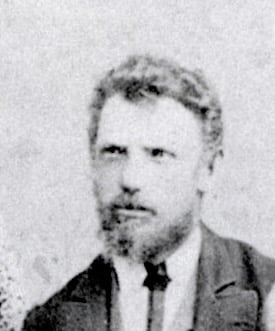
Born March 19th 1852, in Kuttigen, Switzerland, Nicolaus was the fourth child/third son of Andreas (1810 -1861) and Dorothea (1822 - 1896), nee Henning, Niederer. Kuttigen is located in the canton of Aargau, and near the town of Aarau. However, the Niederer family were registered as citizens of Walzenhausen in the Canton of Appenzell, and, in fact, his father, Andreas, was registered as having been born in Walzenhausen.
Andreas was employed as a customs agent and was transferred from Kuttigen to Waldshut, Germany, to collect customs duties. Kolblenz was on the Swiss side of the Rhine River, Waldshut was on the German side.
Andreas died on November 25th 1861, when Nicolaus was just nine years old. Dorothea remarried to Ludwig Eckert, a locksmith. In all correspondence, Nicolaus called him father. Ludwig trained Nicolaus as a locksmith.
Hawking...
Following marrage Nicolaus and Isobella went back to the mainland, to Waikiwi in North Invercargill. Isobella had a store in Mud Road, Waikiwi (later renamed Bainfield Rd.). Nicolaus could see that the store was a poor business, and in an effort to secure the business, he purchased two horses and a wagon, which he loaded with everyday goods from the store and set out as a hawker doing the rounds of the sawmills of Southland, where he became a storekeeper, which led to him developing a hawker's business selling everyday goods from a horse-drawn wagon. He travelled all over Southland, covering mainly the area from Hokonui to Waikawa and stuck at it for some eighteen years, acquiring many contacts and friends. Hokonui is famous for the bootleg production of what locals called Hokonui Whisky, distilled in the Hokonui Hills during the time of prohibition, and Nicolaus carried the sought-after bootleg on every route.
Nicolaus was the 5th of seven children: Friedrich Wilhelm (Fritz) was born April 14th 1844, Herrman, December 19th 1845; Anna Maria, May 26, 1848; Konrad Walther (Walter), December 10, 1849. Nicolaus, March 19, 1852, followed by Anna, December 2nd, 1856 and lastly Ernst Otto (Ernst), April 26, 1860.
During his early life was in Waldshut, Nicolaus was confirmed on Palm Sunday, 1867. Some time in 1871, aged just 19, Nicolaus walked to Hamburg, Germany, to begin work at the Reihersteig Shipyard, where he worked until April 18, 1873. A postcard tells of his departure from Hamburg on June 6th, 1874, when he made his way to London. While in London, he was offered the Queen's Shilling (Queen Victoria) which had he accepted, he would have been conscripted into the Army. Rather than the Army he opted for immigration to Australia, and he caught the vessel, Cartvale.
To New Zealand...
The Cartvale was built in 1872 and departed London on June 25 1874 and was bound for Wellington New Zealand rather than as Nicolaus thought, Australia.
The Cartvale docked in Wellington harbour on October 11, 1874. Nicolas was 22 years of age and described himself in the manifest as a farm labourer. As it turned out his first work was on a Wanganui sheep station. Although he could only speak German, by talking with the farmers children he began to learn english.After a year on the farm he headed south and found work on the Dunedin to Invercargill railway, near the town of Stirling.
During September 1878 Nicolaus ventured further south into Southland where he found work sawmilling, at the Lady Berkly Sawmill near Winton. The sawmill was owned by John Murdoch and derived its name from the steam engine which provided the power for sawing the logs. The engine was originally a locomtive purchased by the Invercargill Council for the Invercargill to Mataura line which was made of wooden rails in order to keep costs down but ultimately it proved uneconomic and bankkruped the Council and was sold to Murdoch.
He further used his sawmilling skills at Tapanui and Woodend, in the area.. At the age of 28 (1880), he was appointed manager of the Mill Creek Saw Mill, Stewart Island. A waterwheel powered the mill, but there was never enough power available for continuous operation and consequently it was necessary to stop work periodically so that the dam could refill with water before work could recommence. Ships had the timber cargo punted out to them at high tide. This system required considerable night work. Ultimately, a tidal wave flooded the mill and shifted it off it foundations. As a consequence, the mill was moved to Halfmoon Bay and erected somewhere near where the baker's shop now stands. A wharf was built so that the timber could be loaded directly onto the ships.
Marrage and family...
In 1882, Nicolaus was appointed to the Stewart Island School committee. In the same year, he married Isobell Urquhart. Isobella (Bella) was the daughter of Hugh Fraser of Rosshire, Scotland. Her marrage to Henry Urquart ended with his death on March 24, 1881, at Lady Berkly sawmill due to a falling tree which was being felled for milling, and as it fell it hit another tree which then fell onto Henry and crushed him to death.
Henry and Nicolaus worked together in a forestry and sawmilling business and were good friends. Isobella and Henry had three children, (Walter Catherine and Jack) and following her marrage to Nicolaus, produced four more.
The children by Nicolas were Dorothea, born February 6, 1883, Anna Bertha, born July 12, 1884, Louis Andreas, born October 4, 1885 and his brother Otto Ernest, born October 28, 1887.
.Gorge Road...
In 1887, Nicolaus decided to take up land at Gorge Road, which was then known as Oteramika Gorge but the name was changed for postal reasons to Gorge Road in 1896. Nicolaus and family were the seventh settlers in the area. Over the years, Nicolaus expanded the landholding to 1,800 acres. When he finally gave up the store and the hawking business and settled on the land at Gorge Road, he was faced with the task of clearing the bush to develop pastures. Backed by his extensive timber and sawmilling experience, he developed the Kahikatea sawmill on his land and began the process of tree felling and clearing. The timber was transported to the Gorge Road rail head by a two kilometre wooden tramline. The mill was a success, but caught fire and burnt down, following which Nicolaus built a flax mill and began harvesting the native flax. The Maori word for flax is Harakeke, and that became the name of the enterprise that Nicolaus developed in Gorge Road. By 1914 Nicolaus had acquired 1,206 acres of land with a capital value of 7,337 pounds.
During 1914, the business of flax and farming at Gorge Road was taken over by his son Louis, and Nicolaus relocated the sawmill to Limehills, where it operated until being sold in July, 1917. Nicolaus was unhappy with his life in Limehills, away from family and Harakeke and his feelings are best summed up by an entry in his diary for the 3rd August 1917, which says "Left Limehills for Good - Hurrah." Following the sale, Nicolaus moved back to the Homestead and pursued his intellectual activities.
In 1935 purchased a house at 78 Canon Street, Invercargill, in 1935 where he lived until he died in December 1938.
The Antichrist...
Nicolaus was a great reader and possessed an extensive library with many of the best books of the day. This contributed to his reputation as a conversationalist. His intellectual enquiries culminated in the publication of "The Antichrist", which expressed his humanist philosophy and his atheist beliefs. The Antichrist was a periodical. He frequently wrote "letters to the editors" of local papers. In those letters, he often questioned and criticised the Catholic church. Indeed, his letters to the local papers were encouraged by the editors as they invariably engendered a response from the church, which led to increased readership and circulation. Nicolaus was a man with very decided opinions on politics, prohibition and religion. A family legend relates that Nicolaus would argue with the Catholic priest about the injustice of the wealthy church taking money each week from the poor and needy. The story goes that Nicolaus and the priest had a fist fight one Sunday after service, and Nicolaus was banished from the canton...a story that gives credence to his departure on foot for Germany and his eventual travels to New Zealand. As to the veracity of the legend...I will leave that to you.
Swiss Family Niederer...
As to his Swiss family, his mother died July 9th, 1896, still clinging to the hope that she would see Nicolaus once more. In a letter she wrote in 1891, she said that she could never leave the house because she must look after the shop and that the goats needed to be milked. Her shop sold toys, brushes, china, and glass.
As to his siblings, Ernst worked as a manservant for a wealthy Parisian family and eventually married Margareth Marie Emillie (nee Fournier). His sister Anna also worked for the same family. Her first husband died after nine months of marrage, and with her second, Baumann, she cared for his two children by a previous marrage and raised them as her own. Both Fritz and Walter wandered around as almost tramps for most of their lives and were often in trouble for petty crimes. Both died in the "poor-house" in Walzenhausen, Switzerland.
Nicolaus died December 27th, 1938, aged 86, and is buried in Invercargill Eastern Cemetery.
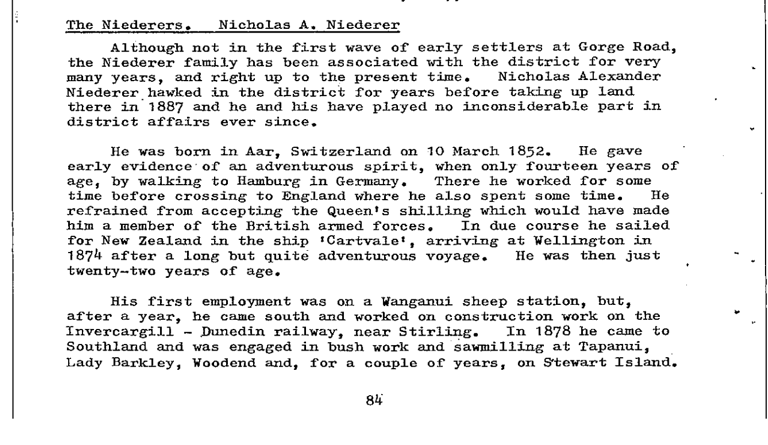
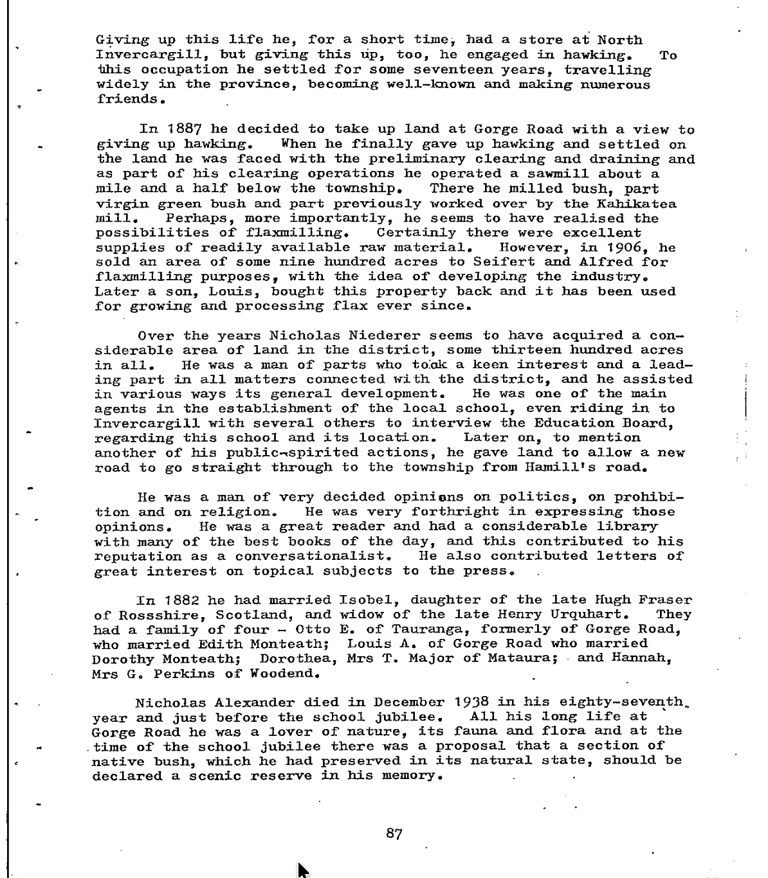
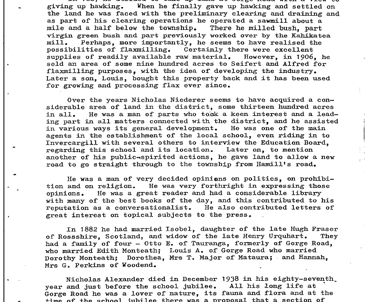
The attached article relating to Nicolaus is an extract from the book "The Gorge Road Story," written by A.H.H. Webster and published in 1970. The book was commissioned by the Committee appointed to oversee the 75th Jubilee of the Gorge Road School and the Centenary of Gorge Road in 1964.
If you have any information regarding the Niederer Family that you are willing to share, or would like to ask a question, please get in touch...
© 2026. All rights reserved.